Issue #04 • Week of September 27, 2026
The Pursuit of Probability
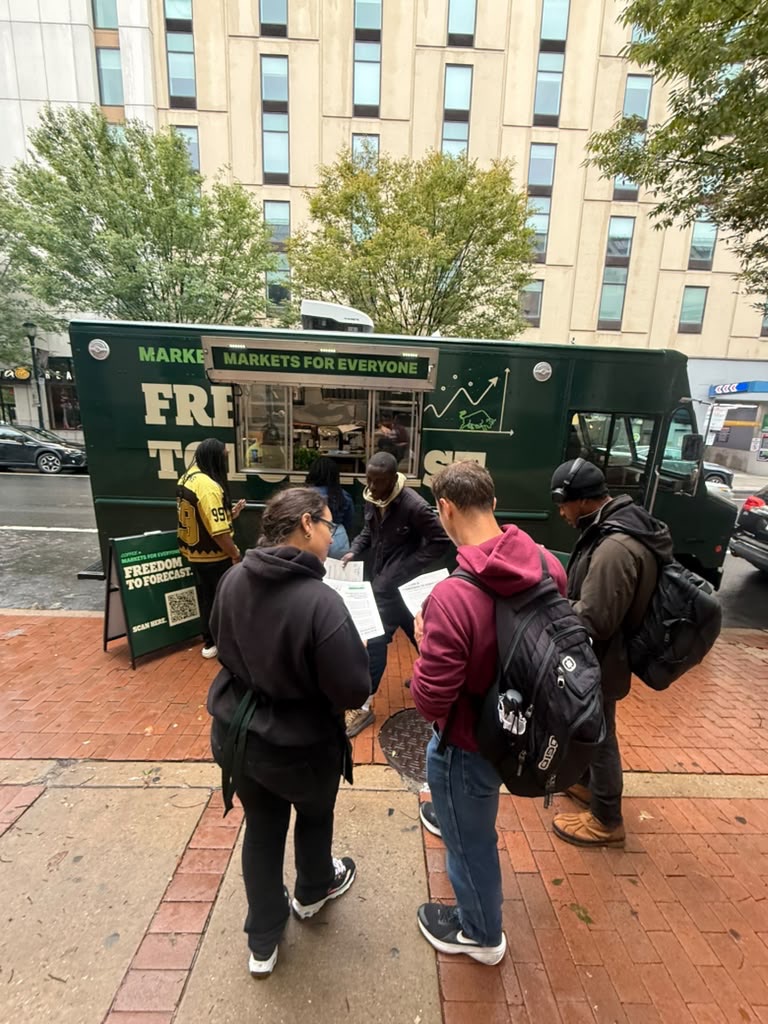
Freedom to Forecast is officially on the road.
This week, a fleet of coffee trucks began its journey across the Lower 48, bringing the conversation around prediction markets directly to communities across the country.
At each stop, people can grab a coffee, learn more about prediction markets, and join a growing community interested in the future of forecasting.
There’s also some pretty cool news. A new study found Kalshi’s weather markets beat the strongest public weather forecast across six of seven cities tested. CBS News put prediction-market probabilities directly into its midterm coverage. And a New Jersey contractor explained how he uses fuel-price markets to protect his business when prices at the pump move against him.
The common thread: probabilities are becoming public information people can actually use.
Follow Freedom to ForecastFreedom to Forecast
The legal landscape also continued to evolve.
On September 25, the Sixth Circuit ruled that Kalshi had not shown its sports-event contracts qualify as “swaps” under federal law, allowing Ohio and Tennessee to enforce their gambling laws while the cases continue. The ruling adds to differing federal appellate decisions involving prediction markets.
Read moreAt the federal level, the CFTC sent two event-contract actions to White House review on September 28: one concerning the treatment of event contracts as swaps and another addressing casino-style gambling products. Neither is final.
Track the CFTC rulemaking
Power, Priced
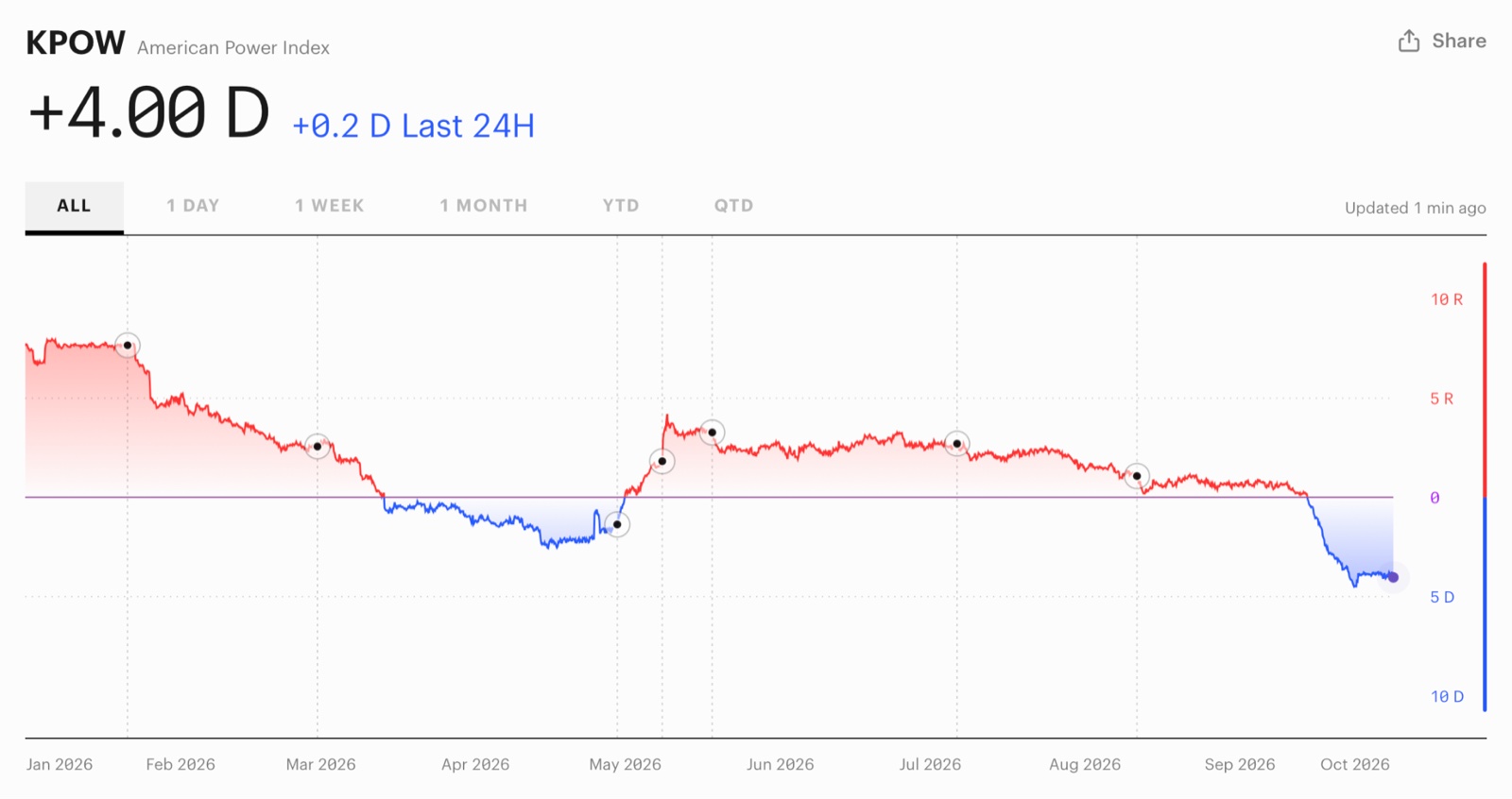
The American Power Index now reads +4.00 D.
That is 0.30 points closer to even than last week’s +4.30 D reading, while the index was up 0.2 D over the prior 24 hours when this week’s screenshot was taken.
KPOW compresses a sprawling question — who holds political power in America? — into one market-based number. It blends current control with forward-looking expectations for the House, Senate and presidency, plus government-function inputs.
The formula is weighted 25% to present control and 75% to future expectations, on a scale from +50 D to +50 R. It is an indicator, not a poll or a tradable contract, and its inputs move as market prices change.
One chart, a lot of politics.
 Learn more about how KPOW works
New at Kalshi
The weather market got graded.
A new paper from researcher Alexander W. Crosier analyzed five years of Kalshi next-day temperature markets across seven U.S. cities.
The result: Kalshi’s market-implied forecast beat the National Blend of Models, the most accurate individual public forecast in the study, in six of the seven cities.
Across the full dataset, the market’s forecast had roughly 10% lower root-mean-square error after its first hour of trading and maintained its lead through the day and overnight.
The interesting part is not that traders built a better weather model. It is that the market gave thousands of people an incentive to find whatever the existing forecasts had missed, then compressed that information into a price everyone could see.
Sometimes the forecast is the product.
Read the study
Kalshi in Culture
Prediction-market odds, now on CBS.
CBS News is integrating Kalshi market data into its 2026 midterm coverage.
This week, CBS election director Anthony Salvanto walked viewers through what prediction markets were pricing for November with a graphic that said it pretty plainly:
PREDICTION MARKET ODDS.
Prediction markets spent years showing up in screenshots, group chats and social feeds.
Now they’re part of the broadcast.
Watch the CBS segment
Markets at Work
Nick Juliano runs Juliano & Son Contracting, a family-owned contracting and hauling company serving northern New Jersey and southern New York.
His trucks run all day. That makes fuel one of the company’s biggest variable expenses, and one Nick cannot simply stop buying when prices rise.
So he started using Kalshi’s fuel-price markets as a hedge.
At first, Nick traded a national gasoline-price market. But his actual exposure was in New Jersey, where prices could move differently. He asked Kalshi for a market tied more closely to his business.
Kalshi launched daily and weekly New Jersey gasoline-price markets.
Now, when Nick thinks fuel prices are heading higher, a position that pays if they do can offset part of the extra cost of keeping his trucks on the road.
For years, small businesses mostly had two options when an uncontrollable cost jumped: absorb it or pass it along.
Prediction markets can add a third.
Read Nick’s story
Seen in the Wild
The prediction-market road show is now an actual road show.
Freedom to Forecast trucks are traveling across the country, bringing free coffee and conversations about prediction markets directly to communities along the way.
 Follow the road show
One More Thing
The NFL still hasn’t announced the Super Bowl LXI halftime headliner.
The market has moved anyway.
As of Thursday, Kalshi traders put Jay-Z at 50% to headline, ahead of Harry Styles at 34% and Miley Cyrus at 29%.
No announcement yet.
The market has a favorite.
Read the latestOutcomes discussed may not be not representative of overall customer performance or success. Past results are not necessarily indicative of future performance